

A beginner friendly introduction to artificial intelligence and what AI means for marketing in professional services and SaaS firms. Learn what AI does, who’s using it, and how to start without the overwhelm.
What Is AI?
If you’ve been scrolling through LinkedIn and emails lately, you’ve noticed artificial intelligence is everywhere. It’s in every strategy deck, every conference keynote, and every email newsletter. Beneath the noise, there’s useful stuff worth understanding for marketing your professional services or SaaS businesses.
Artificial intelligence is technology that allows computers to do things normally requiring human thinking such as learning from data, recognising patterns, making decisions, and generating text and images. Think of AI as a fast, tireless assistant who processes information in seconds, where the same work would take you hours.
Training drives AI. Feed the system vast amounts of data, and AI learns the patterns within. Once trained, AI applies knowledge to new situations, quickly and consistently. The more data you give AI, the better the output.
A Brief History
AI isn’t as new as people might assume. The idea of teaching machines to think dates back to the 1950s. Mathematician and computer scientist Alan Turing posed a question in 1950 about whether a machine might hold a conversation indistinguishable from a human. His Turing Test set the foundation for everything after. For decades, AI progressed in fits and starts.
The 1980s and 1990s brought early expert systems and basic automation.
Then, in the 2010s, something shifted. The explosion of big data and faster computers allowed a branch of AI called machine learning to mature. AI began recognising speech, translating languages, and recommending products based on what you’d already bought.
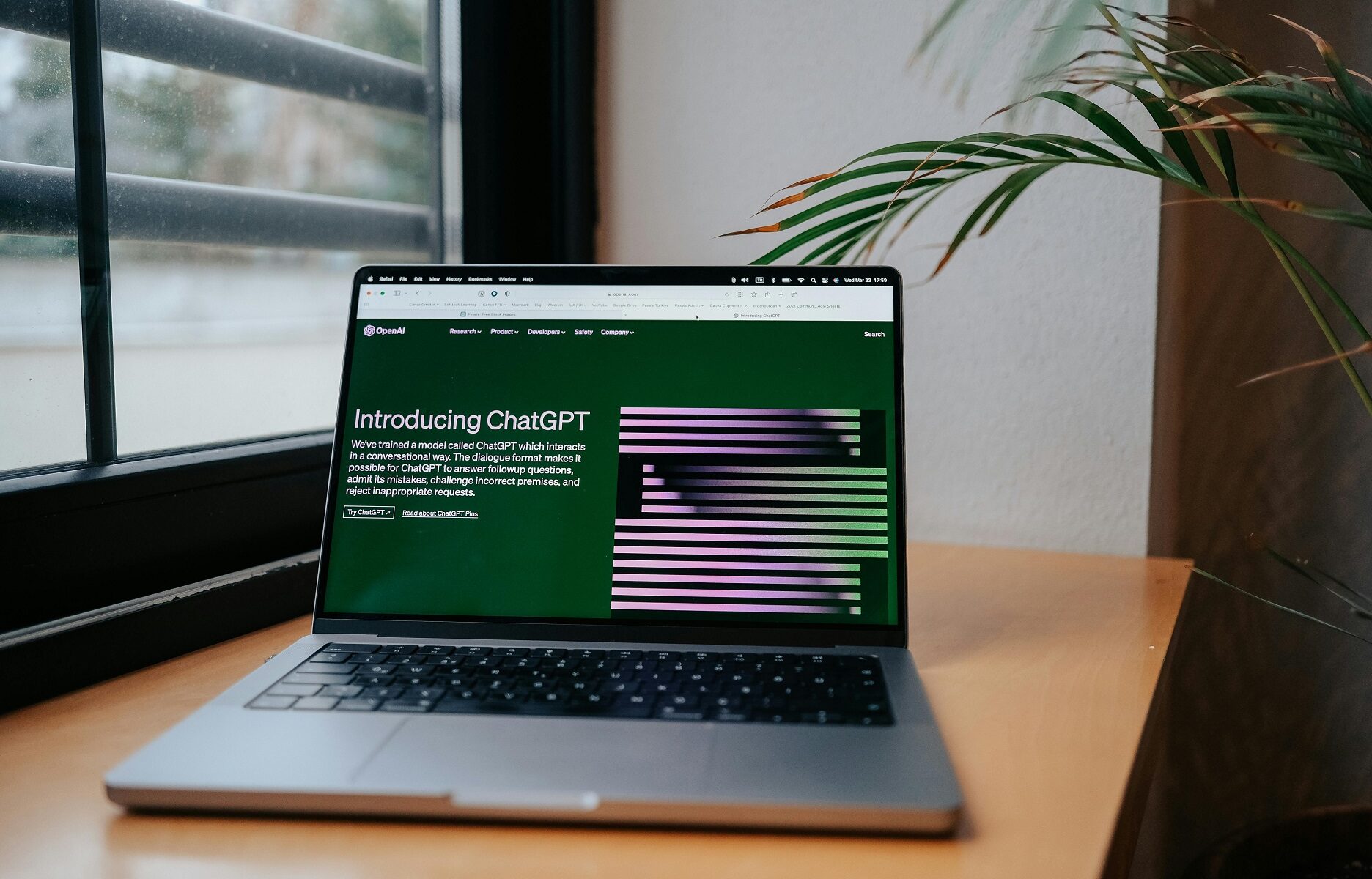
The turning point came on November 30 2022, when OpenAI launched ChatGPT. Overnight, AI moved from a developer tool into something ordinary people used. It started as a free to use chatbot based on the GPT-3.5 model, allowing users to ask questions and get back human-like conversational text. For marketers, this was the moment AI became a tool they could actually use every day.
Why Should You Care About AI?
Your clients are already paying attention to AI. Some are already using it. If you’re not up to speed, you’ll notice the gap.
A 2025 survey by Moneypenny of 750 UK business decision-makers found 39% of UK businesses are already using AI in some form. Another 31% are seriously considering adoption. Total interest sits at nearly 70%.
In the sectors you’re most likely working in, adoption is already significant. Finance leads with 83% of businesses either fully embracing or selectively using AI. HR follows at 76%. For firms in accountancy, HR, education, healthcare, or SaaS, AI isn’t a future consideration for them. It’s a present-tense conversation.
The Office for National Statistics confirms this trend at a national level. Nearly a quarter (23%) of UK businesses reported using some form of AI technology in late September 2025. That’s up three percentage points from June 2025. The proportion has risen steadily since ONS first tracked the question in September 2023, when adoption stood at 9%.
As a professional services or SaaS firm, this means two things. First, AI will save you time and sharpen the work and marketing that you deliver. Second, understanding AI positions you as a forward-thinking partner.
What Does AI Do for Marketing?
Here’s where AI fits into day to day marketing:
Content creation and ideation.
AI drafts blog posts, social media captions, email subject lines, and ad copy in seconds. But the output needs your eye before it goes anywhere near a client. Your experience and brand knowledge are what turn a decent draft into something worth publishing. Check it carefully. Edit ruthlessly. AI gives you the raw material. You decide what’s good enough to use.
Research and audience insights.
AI tools analyse data on audience behaviour, competitor positioning, and market trends far faster than you would manually. For professional services firms trying to stand out in a crowded market, this kind of insight is valuable.
Personalisation at scale.
One of the biggest challenges for SaaS and professional services marketers is making communications feel relevant to each individual. AI-powered tools now personalise email sequences, website content, and ad messaging based on user behaviour. You don’t need to manually segment and rewrite for every group.
Automation of repetitive tasks.
Scheduling social posts, updating CRM records, responding to basic client queries, analysing campaign performance. These tasks eat into your day. AI handles many of them, freeing you to focus on strategic and creative work.
Among UK SMEs already using or planning to use AI, 54% are turning to AI for task automation. 45% are using AI specifically for marketing or advertising.
Who’s Using AI, and What for?
Plenty of firms and people are still figuring out how best to use AI. You’re not alone or behind.
A YouGov survey of 1,000 UK SME decision makers in August 2025 found 31% of SMEs are actively using AI powered tools. IT and telecoms (56%) and media, marketing, and advertising (53%) lead adoption across all sectors.
Among larger organisations, the picture is more advanced. The UK AI market is now valued at £21 billion, one of the fastest growing technology sectors in Europe. 92% of executives plan to increase their AI investment over the next three years.
For professional services firms specifically, the following AI enhanced benefits are already showing up:
- Accountancy practices use AI to speed up client communications and automate routine reporting.
- HR teams deploy AI for recruitment screening and employee engagement analysis.
- Education providers are using AI to personalise student communications, automate admissions responses, and provide instant academic support through virtual assistants.
- Healthcare organisations use AI to improve patient facing communications and administrative efficiency.
- Law firms are adopting AI to streamline document review, draft standard contracts, and improve client communications by delivering faster, clearer updates on cases.
- SaaS companies are embedding AI directly into their products to enhance user experience.
When Did AI Start Gaining Momentum?
The timeline for AI in marketing looks like this:
- The early tools, basic chatbots and simple automation, started appearing around 2018 to 2020.
- Generative AI, the kind writing, creating images, and holding conversations, became mainstream from 2023 onwards.
- In 2025 and into 2026, AI is shifting from “interesting experiment” to “standard part of the marketing toolkit.”
An EY AI Sentiment Index survey of 15,000 people across 15 countries found 70% of UK respondents have consciously used AI in their daily lives in the past six months. Workplace adoption sits at 44%, behind the global average of 67%.
The gap between personal use and professional use is an opportunity for you. Help your clients close the gap, and you’re delivering real value.
How Do You Start Using AI Without Feeling Overwhelmed?
The good news is you don’t need to be technical and you don’t need to understand how AI works behind the scenes. Start experimenting with the tools already available.
Pick one repetitive task you do every week e.g. writing a newsletter, drafting social posts, summarising meeting notes. Try doing the task with an AI tool first. Compare the output to what you would have produced. Refine the output with your own expertise and brand knowledge. Then repeat. Use each round to sharpen how you work with AI.
Over time, you’ll build an instinct for where AI adds the most value and where your human judgement is still needed. The best results come from treating AI as a collaborator. Give AI a brief. Review the output. Shape the final version together. Build this into your workflow.
Why Does AI Matter, Beyond The Hype?
AI is changing the baseline of what’s expected. Clients will increasingly expect faster turnaround, sharper insights, and more personalised campaigns. The professional services and SaaS firms who thrive will use AI enhanced marketing to deliver all of the above while still bringing the strategic thinking, creativity, and client understanding no algorithm replicates.
The ONS data shows 36% of businesses planning to adopt AI intend to train or retrain existing staff rather than replace roles. 69% of firms adopting AI cited improving the quality or efficiency of processes as their primary motivation.
This isn’t about being replaced. It’s about being better equipped.
What If You’re Still Not Sure About AI?
That’s completely normal. Even among UK SMEs familiar with AI, 49% of those not yet planning to adopt AI cite concerns around data privacy and security. 58% worry leaning too heavily on AI will reduce business creativity.
Those are legitimate concerns. On privacy, avoid putting sensitive client data into AI tools unless you’ve confirmed the platform is GDPR compliant and the data isn’t being used to train the model. On creativity, the evidence points the other way. AI tends to free up creative professionals to do more of the high-value, imaginative work.
Businesses struggling aren’t the cautious ones. They’re the ones who refuse to engage.
Where Is AI Heading for B2B Marketing?
Over the next twelve months, AI will become more deeply woven into the tools you already use. Marketing tools such as HubSpot, Mailchimp, Canva, Google Ads, and LinkedIn are all building AI features directly into their platforms. You won’t need to seek out AI separately. AI will become part of how you work.
For professional services and SaaS marketers specifically, the biggest shifts are likely in three areas:
- Hyper-personalised content at scale, where AI tailors messaging to individual prospects based on their behaviour and interests.
- Predictive analytics, where AI helps you forecast which campaigns will perform before you spend the budget.
- AI-assisted client reporting, where insights are generated and presented automatically, saving you hours each month.
No-code and low-code AI platforms are also rising fast. What once required specialised data science teams and costly infrastructure is now accessible to marketers with minimal technical expertise. The interfaces are intuitive. The templates are pre-built.
The barriers to entry are dropping fast. The tools are getting simpler. The results are getting stronger. The window to get ahead of this is right now.
Your Next step?
Getting a head start needs your curiosity, a willingness to experiment, and the sense to start small. You don’t need a master’s degree in computer science or a six-figure budget.
Start by focusing on one marketing task you do regularly. Use an AI tool to take a first crack at the task. Spend ten minutes refining the output with your own knowledge and creativity. Notice where AI helped. Notice where your expertise made the difference. That’s your starting point. From there, everything else follows.
AI isn’t the future of marketing, it’s already here for professional services firms who embrace it thoughtfully.
If you’d like to explore how AI-enhanced marketing works in practice, get in touch. Let’s chat about combining AI tools with marketing experience and human judgement to get measurable results for your business.